 Australian Army Cadets
Welcome to CadetNet 365
The transition to Microsoft 365 (M365) represents a significant upgrade to our national collaboration capabilities. While this move brings modern tools like Teams and OneDrive to every cadet and volunteer, we acknowledge there are some initial "teething issues" as we fine-tune the security settings.
⚠️ Known Issue: MFA Login Loop
We are currently investigating a persistent issue where some users are stuck in a "Let's keep your account secure" loop when accessing apps.cadetnet.gov.au. This is being treated as a high priority. An active investigation is underway to resolve the conflict between our security proxies and session management. We appreciate your patience while we fix this.
1. First Step: Mandatory MFA
To meet Defence security standards, you must register two forms of Multi-Factor Authentication. We strongly recommend downloading the Microsoft Authenticator App as your primary method, as it is more reliable than SMS.
2. Accessing the Portal
Your new digital home is apps.cadetnet.gov.au. Log in using your full @armycadets.gov.au email address. From here, you can launch Outlook, Teams, and Word directly in your browser.
3. Mobile Access
Do not use the default mail app on your phone. You must download the Microsoft Outlook App from the App Store or Google Play to access your CadetNet email on mobile.
Troubleshooting & Tips
If you are experiencing issues with files or logging in, please check the following before raising a ticket:
- Browser Choice: Use Microsoft Edge for the best compatibility. Avoid "Incognito" or "Private" windows as they often break the MFA connection.
- Document Editing (MCAS): If you cannot edit or save a document, you may need to apply a Sensitivity Label (e.g., OFFICIAL) from the toolbar. This ensures the security metadata is saved correctly.
- Cache Issues: If you are stuck in a loop, try signing out completely and clearing your browser cache.

Torch and Sword edition 4
The Australian Army Cadet (AAC) newsletter showcases stories, competitions, and guidance on all things Cadets and Staff, and recognise the contributions of our volunteers and the community to make it happen.
This issue has a focus on the National activities available to cadets and staff, and serves as an introduction to what you can participate in, or support.
Download your copy below!

![AAC Newsletter Website Thumbnail [150Ppi 56KB]](/media/202jxizf/aac-newsletter-website-thumbnail-150ppi-56kb.jpg)
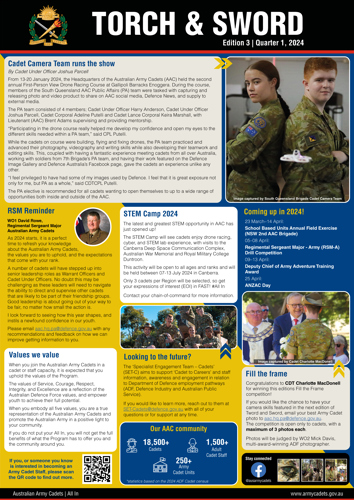
Torch and Sword edition 3
The Australian Army Cadet (AAC) newsletter showcases stories, competitions, and guidance on all things Cadets and Staff, and recognise the contributions of our volunteers and the community to make it happen.
This quarters issue has a focus on what the Cadet Development Continuum offers to cadets, upcoming events, STEM Camp, photography competition, and a message from the Australian Army Cadet Regimental Sergeant Major, WO1 David Rowe.
Download your copy below
Interactive PDF for online viewing

![AAC Newsletter Quarter 4 2023 Website Thumbnail [150Ppi 30KB]](/media/ijfdy5c1/aac-newsletter-quarter-4-2023-website-thumbnail-150ppi-30kb.jpg)
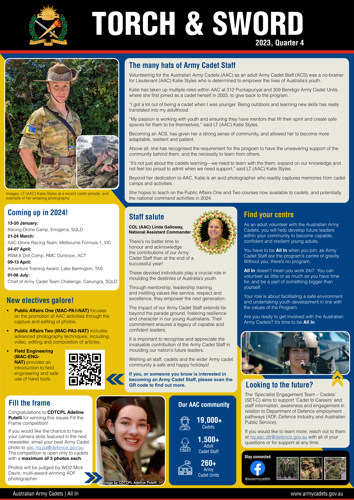
Torch and Sword Q4 2023
The Australian Army Cadet (AAC) newsletters showcase stories, competitions, and guidance on all things Cadets and Staff, and recognise the contributions of our volunteers and the community to make it happen.
This quarters issue has a focus on Army Cadet Staff and their contribution to the Program, new electives, upcoming events, photography competition, and a message from the National Assistant Commander, Colonel (AAC) Linda Galloway.
Download your copy below
Interactive PDF for online viewing
High quality JPEG for print

Torch and Sword Q3 2023
The Australian Army Cadet (AAC) newsletters showcase stories, competitions, and guidance on all things Cadets and Staff, and recognise the contributions of our volunteers and the community to make it happen.
This quarters issue features a story on the AAC Drone Racing Team, AAC tagline refresh, and a message from the AAC Commander, Brigadier Benjamin Slaughter.
To download your copy click here
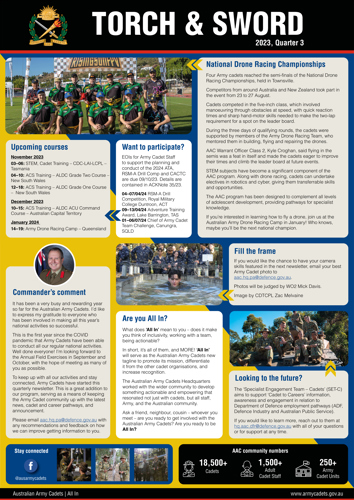

Drone racing team retains world title
In an epic battle, the Australian Army Drone Racing Team (AADRT) retained its championship title at the Military International Drone Racing Tournament at the beginning of March.
Held during the Australian International Airshow, teams from Singapore, Indonesia, the United Kingdom and New Zealand competed in the three-day event against the Australian Army and Air Force teams at Avalon in early March.
In a thrilling finish, the AADRT just edged ahead of New Zealand to retain the title.
Pte Hamish Glover set the quickest time around the track to become the fastest individual pilot.
Army team captain Spr Alex Brown was thrilled at the win and the high standard of racing demonstrated.
“The level of skill among all the pilots just keeps getting better,” Spr Brown said.
“It has been a fantastic week of racing, teamwork and friendly rivalry.”
“To have six military drone racing teams here at Avalon is a huge thrill and is evidence of the growing popularity of the sport.”
In another first, the Australian Army Cadets Drone Racing Team competed, with five of the fastest cadet drone racers displaying their flying, building and repairing skills. Cdt Cpl Lewis Sanderson won the Champion ADF Cadet pilot trophy.
“It’s amazing to be here at the Avalon Airshow and be part of the drone racing in this huge tent with some of the fastest racers in the world,” Cdt Cpl Sanderson said.
“I have learnt so much, and it is especially exciting to meet and fly with the world champion, Thomas Bitmatta.”
Long-time supporter of the ADF drone racing teams, world champion drone racer Thomas Bitmatta, passed on some of his knowledge and advice to the pilots.
“I am always so impressed by the quality of drone racing at these events and also just the friendships and camaraderie among the pilots,” he said.
“There is always someone ready to help out with a spare part or advice to keep everyone in the air.”
Drone racing is an authorised and encouraged adaptive sport in the Australian Army.
Above original particle posted in the Army newspaper (edition 1531), page 20.
The Australian Army Cadets also enables cadets to undertake training on the use of Multi-Rotor Unmanned Aerial Vehicle (MRUAS) as part of the Cadet Development Continuum.
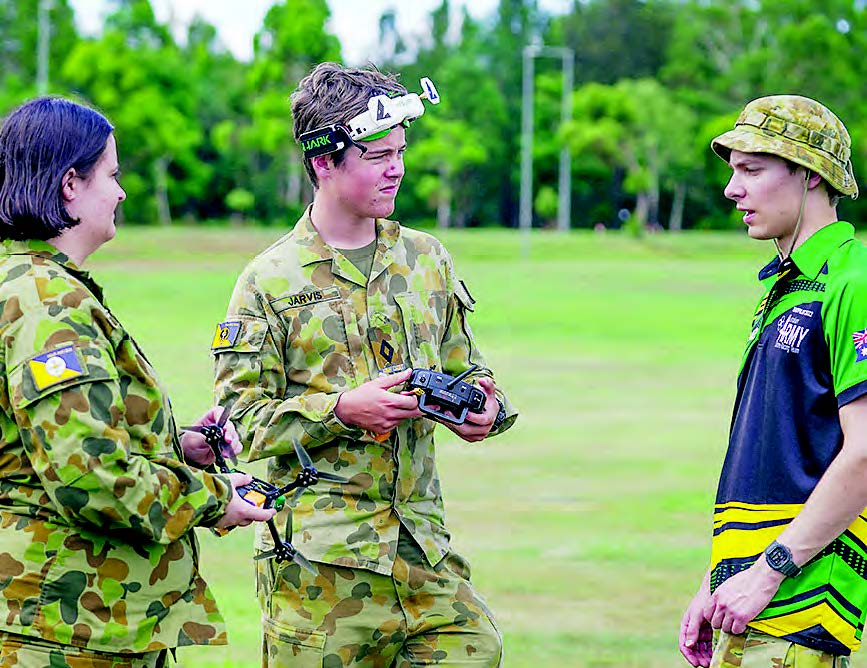
Cadets take wing at drone camp
Six Army cadets were offered places on the Australian Army Cadet Drone Racing Team (ACDRT) after a drone racing camp at Gallipoli Barracks in January.
Twelve cadets from units around Australia participated in the five-day camp as part of the cadet training elective program, where they learnt to build, code and fly racing drones under the instruction of pilots from the Army Drone Racing Team (ADRT).
The cadets’ experience handling and operating the drones developed a greater proficiency in drone technology that they can take back to their home units.
The ACDRT will compete in the Military International Drone Racing Tournament at the Avalon International Air Show next month.
One of the six selected was Cadet Cpl Oliver Cawood, from 422 Army Cadet Unit St Michael’s College in Adelaide, who said he enjoyed how the camp built on his previous experience in a fun way.
“It has been a lot of fun and really interesting building my own drone and then learning how to program and fly it,” Cadet Cpl Cawood said.
“I was really excited to actually get it out on the track, and I was practising on the simulators every chance I could get.”
“I have only ever flown a line-ofsight drone before but I have realised that racing drones with the first-personview googles is a lot more challenging, but a lot more fun, too.”
For Cadet Cpl Lewis Sanderson, from 126 Army Cadet Unit Pine Rivers in Brisbane, the course was the first time he had flown a drone. His natural talent became evident, taking out the overall fastest time, and even beating the ADRT captain in a battle on the simulators.
Drone racer and captain of the ADRT, Spr Alex Brown, said the week was a fantastic opportunity to share his passion for drones and pass on his knowledge to the cadets.
“This week has been about giving cadets the opportunity to experience drone racing and really get hands-on with the building, coding, soldering and repairing,” Spr Brown said.
“A lot of the cadets have drones at home or school, but not many have been exposed to drone racing before.
“It’s amazing to see how quick they have picked it up. There is a lot of talent in the group and it will be great to see the Army cadets represented at the tournament in Avalon.”
The ADRT focuses on youth engagement and STEM pathways, supporting events in collaboration with cadets and Defence recruiting, to share their passion for drones with the public.
Original article posted in the Army newspaper (edition 1528), page 14.
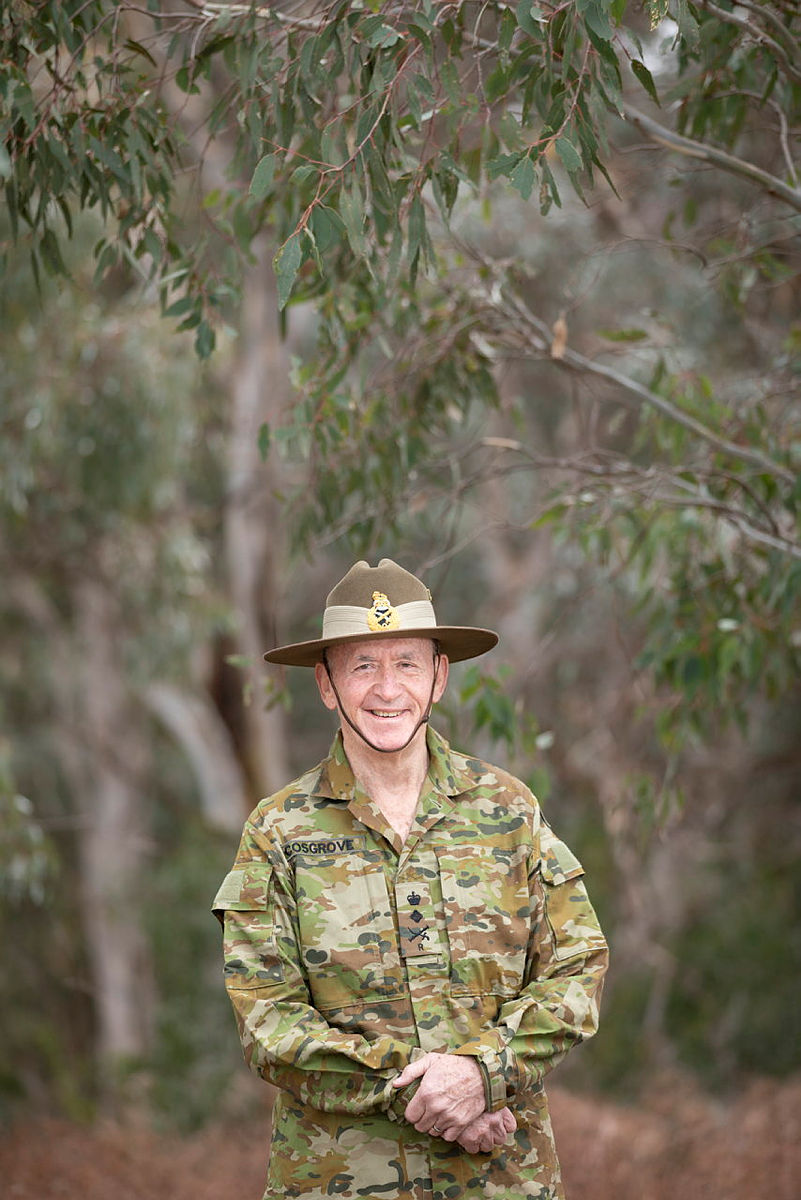
ADF Cadets Patron - End-of-year Message
From natural disasters to a global pandemic, we have endured quite a lot as a society over the last few years. As we come to the end of 2022, we have a great opportunity to reflect on what we have achieved in the face of adversity.
Cadet units across the country have proven to be strong and capable. With the many challenges that have been thrown at them in recent years, they continue to show remarkable resilience and adaptability. The different restrictions from state to state meant different models of operation – some units were able to operate as usual, while others adjusted to going online for parade using modern technology, or going old-school and using snail mail!
Things might have felt a little different for everyone this year. We’ve learned new ways of approaching life and to appreciate being together more. I know cadets have had a great time getting back into the great outdoors and participating in various activities. Some notable ones include the Navy Cadets National Training Camp held at HMAS Cerberus, the Chief of Army Cadet Team Challenge held in Puckapunyal and the Annual Field Exercises which were enjoyed by Army Cadets, and the recent National Parade at the Australian Defence Force Academy to mark the 80th Anniversary of the Air Force Cadets.
Next year, units can look forward to a national cadet leadership summit in Canberra; Navy Cadets Fleet Engagement Camp in Sydney; Army Cadets Adventure Training in Tasmania, Regimental Sergeant Major – Army Drill Competition in Canberra, and the Chief of Army Cadet Team Challenge in Canungra; and Air Force Cadets National Rifle Competition in Sydney towards the end of the year; among other activities.
I sincerely hope that all our cadets, cadet staff and their families have a chance to take a break and reunite with loved ones in the coming weeks, and I’d like to wish everyone a happy and safe festive season.
The year ahead holds some great opportunities for me to get out into the cadet community and I’m looking forward to meeting you at some of your activities.
Best wishes to you all.
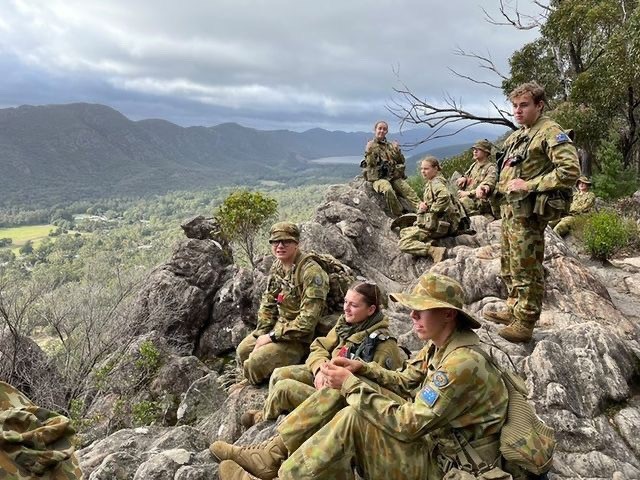
The Australian Army Cadets’ All Female Leadership Team
The Australian Army Cadets’ all female leadership team focuses on equity for all
The theme of International Women’s Day 2022 was “Break the Bias”. Based on the recent appointment of an all-female leadership team in the Australian Army Cadets (AAC), the program is making positive moves in this direction and the strong and capable team of four have already made their leadership presence felt.
Four outstanding leaders from across four states make up the National Cadet Leadership Team. Amelia Bau from South Australia – National Cadet Under Officer, Emily Flude from Tasmania – National Cadet Regimental Sergeant Major, Kasey Yates from NSW – National Cadet Training Officer and Tessa Zangalis from Victoria – National Cadet Adjutant were recently appointed to represent Army cadets across Australia.
The first all-female leadership team is building on the theme of ‘equity for all’ and is focused on enhancing programs and structures that cater to the broad diversity of over 18,000 Army Cadets from over 250 units around the country to support their growth as leaders in their communities.
The AAC is the youth development program of the Australian Army and focuses on building resilience and leadership capability through professional training and skills development.
Army Cadets National Assistant Commander, Colonel (AAC) David Hill has been extremely pleased with the appointment of the four new Cadet leaders.
“These young people have the responsibility of representing and shaping all of our cadets to be their best selves,” Colonel Hill said.
Army Cadets provides opportunities for youth across Australia to learn and develop life skills that are not always taught in the contemporary classroom. The curriculum caters to a wide array of interests such as Science, Technology, Engineering, and Mathematics (STEM)-focused activities, including technology, first aid skills, engineering and survival, and provides an opportunity for youth from diverse backgrounds to connect, resulting in a community of individuals focused on excellence.
Colonel Hill said AAC strives to operate in a respectful, supportive and mature environment to bring out the best in youth, not just within the organisation, but in the communities they serve.
“Our Cadet leaders have demonstrated a maturity and commitment to our Army Cadets values of Service, Courage, Respect, Integrity and Excellence in the best possible way,” Colonel Hill said.
According to National Cadet Under Officer Amelia Bau, the AAC program is far more than just the surface image of weekend bivouacs and practising marksmanship. The Cadets Program is an opportunity for young people to become exceptional leaders whilst developing their technical skills. “The more you apply yourself, the more opportunities you will be presented with,” she says. “The more opportunities you are presented with, the more you will improve and develop. Through the program I have been able to create connections with cadets from across my state, and across the country. Being in the Senior Cadet Leadership Group for the past three years means I have had the privilege of working with other senior appointed cadets from different brigades. This has allowed me to better understand the program from multiple perspectives, as well as develop a network of hard working individuals I can rely on.”
National Cadet Regimental Sergeant Major Emily Flude believes the opportunities that are offered through or in conjunction with the AAC are endless. “I like to take up every opportunity that is presented to me, but even I can’t keep up with all the different opportunities that are offered,” she says. “They range from participating in activities with the other Cadet programs to travelling around Australia for various activities. As this year’s Leadership Team is located around Australia, we hope to make a difference by having open lines of communication, and integration between the different States and Regions so that we can have a successful year despite the challenges posed, especially by COVID.”
According to National Cadet Training Officer Kasey Yates, the AAC program offers a safe and diverse space that helps young individuals to shape our future. “On entering the Cadets, I was surprised at the amazing opportunities it presented, such as participating in the NSW Adventure Training Award which allowed me to network and create unbreakable friendships throughout all NSW,” said Kasey. “I am really proud to be currently working with both the National Cadet team and the CDC team through the process of the Learning to Learn initiative. This will help to improve learning and inclusion for all Cadets nation-wide.”
National Cadet Adjutant Tessa Zangalis found the leadership opportunities are a surprising but added bonus to the full complement of activities and experiences available to her since joining Army Cadets.
“What surprised me the most about Army Cadets was the leadership opportunities available, and for me, it has been the most valuable aspect of cadets,” she said.
“Being able to run activities and shape other cadets to be their best selves is something I never would have expected but am forever grateful for. I remember one of my first parade nights as a recruit, and I was stunned by the maturity of the Non Commissioned Officers who were not much older than me. The emphasis on respect and discipline was a welcome surprise, for sure.”
If you would like to know more about the Australian Army Cadets, or are interested in joining, you can find your local unit and contacts at www.armycadets.gov.au
(Main Picture) National Cadet Adjutant Tessa Zangalis (front, centre) participating in the AAC Adventure Training Awards in the Victorian Grampians - one of the many opportunities provided through the Australian Army Cadet Program.
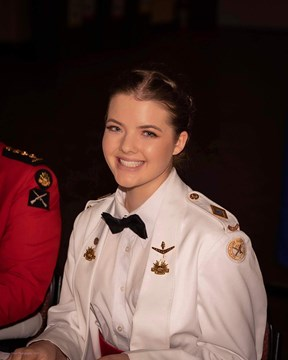
National Cadet Under Officer Amelia Bau as Dining President at the 2021 South Australian Tri-Service Cadets’ Ball.
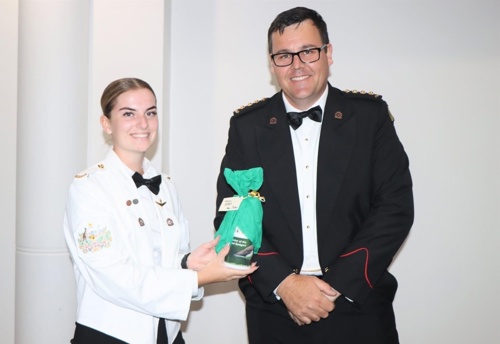
National Cadet Training Officer Kasey Yates a the 26 ACU Wollongong NSW, 2021 dining in night, alongside Captain (AAC) Wade Priestly.
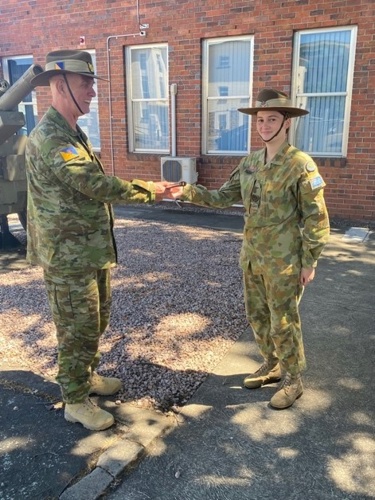
Cadet Warrant Officer Emily Flude receiving her Pace Stick from COL (AAC) David Hill when appointed as the National Cadet Regimental Sergeant Major.
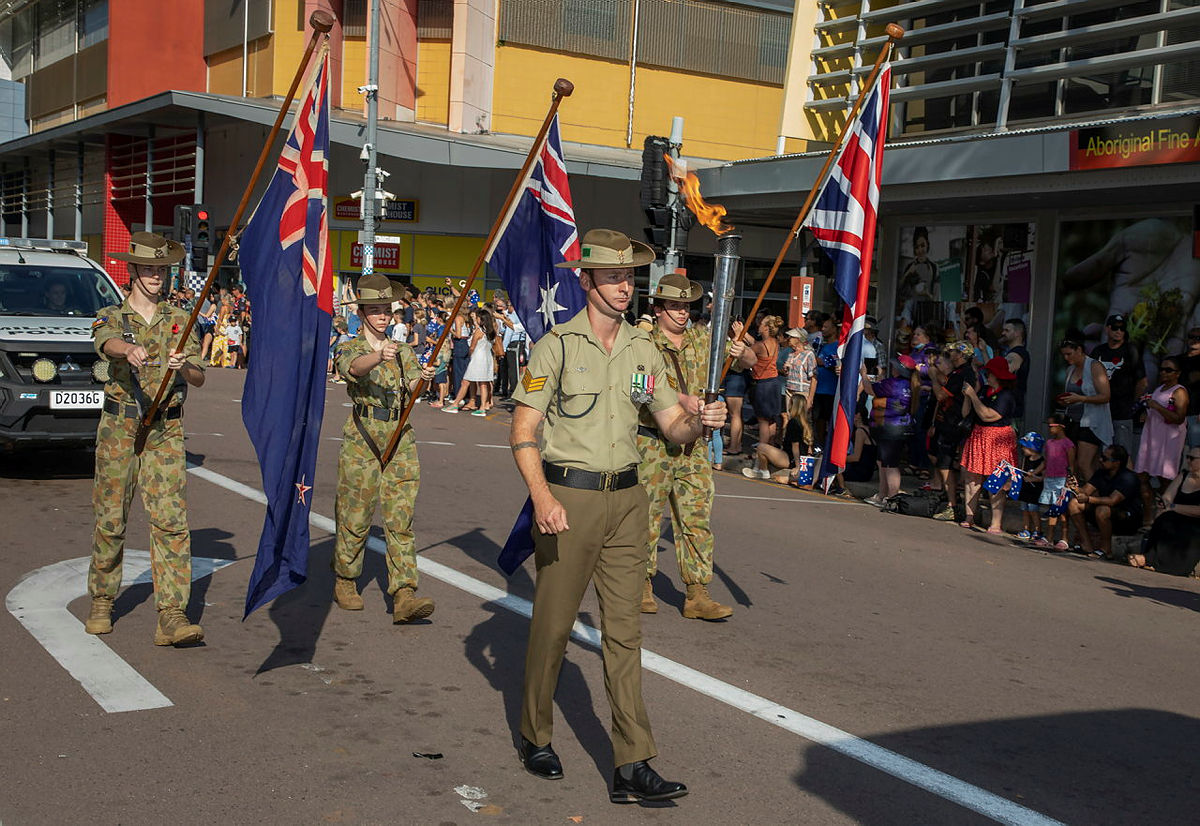
Anzac Day 2022
Army Cadets across Australia relished the opportunity to return to the support of community Anzac Day commemorations on 25 April 2022.
Many Army Cadets had attended personal commemorations in their driveways or other locations in 2020 and there had been a limited participation in community ceremonies in 2021. However last month Australian Army Cadets (AAC) could fully support activities across the nation with only minor restrictions, for the first time in three years.
For most Australian towns, particularly in the regions, Army Cadets provide the only direct link between the community and the ADF. Over 9300 Army Cadets and Adult Cadet Staff supported community commemorations for ANZAC Day 2022.
From mounting catafalque parties to carrying RSL banners, providing musical support or helping ageing veterans, Army Cadets participated in a total of 337 Anzac Day activities in every State and Territory of Australia.
Commander AAC Brigadier Ben Slaughter, who with RSM AAC, Warrant Officer Class 1 David Rowe, attended the Anzac Day Service in Geelong with cadets from 32 Army Cadet Unit (ACU), said that Anzac Day is an important part of the Army Cadet Calendar. “Our cadets are very proud to represent Army and honour Defence members who have sacrificed much serving our nation,” he said.
Image caption: 1. Cadet Corporals Cody Munday, 71 ACU (left) and Caitlin Dempsey-Haala, 70 ACU and Cadet Brandon Erkelens, 71 ACU, form the flag party for the 2022 Anzac Day Parade in Darwin, Northern Territory.
Cadets Relish Return to Field Training
Australian Army Cadets (AAC) around Australia conducted exercises and courses that varied from state to state in the September/October 2021 school holidays.
All AAC Brigades traditionally conduct their Annual Field Exercises (AFX) in the spring school holidays. This year, for the second year in a row, each regional Brigade or Battalion had to adapt the specific COVID-19 restrictions that applied in its State or Territory.
Whilst varying degrees of lockdown in all of the eastern states restricted their Brigades to the conduct of online courses and camps, Western Australia, Tasmania, South Australia and the Northern Territory were able to return to the field for their AFX or courses camps.
“Due to COVID-19, there had been a massive lack of outside training in the first half of the year”, said Cadet Under Officer (CUO) Emerald Kidd, of the Tasmanian AAC Battalion. “So everyone was keen to get back out in the field for the AFX”, she added.
While the outer states were not in lock down, numerous COVID related restrictions affected the way that the AFXs could be conducted and each regional Headquarters adapted to meet the challenges of conducting a safe activity.
Western Australia AAC Brigade met the challenge by allocating a separate Area of Operations within the same training area to each battalion in the Brigade. “The separate AO model was a first, but worked well and was very well received,” said Colonel David Jones, the Brigade Commander. “We achieved the necessary cohorting and controls while able to provide close support and efficiencies within the overall training area,” he added.
The WA Brigade AFX at Bindoon Training Area featured abseiling and engineering activities and range practices. ADF support and visits to the exercise came from 16 RWAR and 10 LHR, with the Bushmaster and Hawkei vehicles on display proving a hit with the cadets.
SA Brigade also conducted a split AFX, with over 500 cadets exercising at three separate training areas, Murray Bridge, Koltana and Mount Gambier. Recent graduates of the Brigade Public Affairs course publicised the broad range of courses on offer in daily facebook posts featuring videos from Regional CUO Amelia Bau and Regional Cadet WO Harriett White.
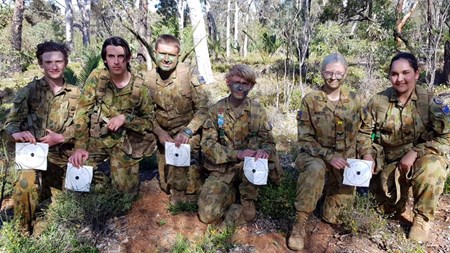
Tasmania Battalion was small enough to conduct a single AFX at Stony Head Training Area, with ADF personnel assisting with safety at the range practices. The AFX also featured attendance by a group of Australian Navy Cadets.
“We’ve always encouraged cadets from Navy and Air Force Cadets to attend our activities”, explains CUO Kidd. “It was amazing to see the Navy Cadets training with us and learning Army skills like Radio Telephone Procedure”, she said.
The Tasmanian Battalion AFX also featured a Navigation challenge in sections, a Company versus Company “Olympics” competition and a visit from the Governor, the Honourable Barbara Baker, AC.
The Australian Army Cadets (AAC) provides a personal development program for young people and is conducted by the Australian Army in cooperation with the community and aims to benefit the nation by developing individuals and their communities.
The AAC adopts the values of the Australian Army – Service, Courage, Respect, Integrity and Excellence – to empower youth to achieve their potential.
There are more than 17,500 Army Cadets based in over 240 units around Australia